
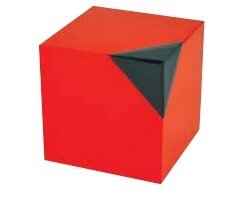
What is a Tetrahedron?
The tetrahedron is one of the most fundamental and visually captivating geometric shapes. Comprised of four equilateral triangular faces, this three-dimensional solid showcases symmetry and simplicity in its design, making it a cornerstone of geometric studies and applications.
The Process of Formation
Creating a tetrahedron involves connecting four points such that no three are collinear. These points form vertices, connected by edges to shape its four triangular faces. This precise process makes the tetrahedron not only an essential structure in mathematics but also a practical form in architecture and design.
Applications and Relevance
Tetrahedrons extend beyond theory—playing a significant role in fields like molecular chemistry, structural engineering, and even art. Their inherent stability makes them foundational in various applications, demonstrating their importance in both scientific and creative domains.

Reviews
There are no reviews yet.